Those of you who know us know that we have a thirst for adventure. We’re usually agreeable to just about anything, but if you didn’t already know, driving exclusively from Alaska to Argentina is an impossible feat. The reason is an approximate sixty miles of roadless, swampy, mountainous stretch of land between Panama and Colombia called the Darien Gap. If the untamed terrain doesn’t get you, the desperados and drug cartel very well may.
There have been a few brave, or crazy, souls who have made it through, but others have died trying. Needless to say, we decided not to attempt it. Instead, we would have to put Tomás’ big ol’ booty and two-wheel drive capacity on a cargo ship in Panama and pick him up a few days later in Colombia.
Since we wanted to drive every last drivable inch of the Pan-American Highway, we decided to push as far as possible before surrendering to our fated crossing without Tomás. That “end of the road” turned out to be a small town tucked inside Panama’s Darién Province called Yaviza.
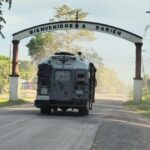
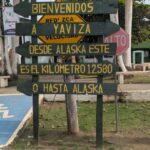
Using our travel app (iOverlander) we found a place to stay that was secure and, most importantly to our budget, free. There was just one review, and all it said was the owner was a great guy and you could hire a local boat driver to take you to an indigenous village three hours upriver into the infamous Darien. In my mind it was some sort of local tour, so we asked the property caretaker about it.
“Yes, of course,” he told us. “The boat will leave at nine tomorrow morning.”
At nine o’clock on the dot (bless our American hearts), we inquired with the caretaker, Robinson. He told us a bus was coming with more passengers, but it was a little delayed, la carretera es muy mal. We knew the road was bad—mostly gravel or mud and littered with potholes and construction delays, as we had driven it just the previous night. In the meantime, he took us to meet our boat captain and the local police to get permission to visit the village.
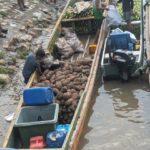
A short walk later, we reached the docks where the plantain long boats were offloading their cargo. Barefoot men, like a colony of leafcutter ants, hurried surefooted down the bank with empty baskets, then headed back up with them overflowing with large, green plantains. At the end of a dock that was missing half its planks and heavily listing to one side, we met our captain. With a man named Robinson escorting us and a boat that looked like it would have to be bailed along the way, I was grateful the vessel had not been christened the SS Minnow for this three-hour tour. We all know how that turned out.
The police permission was as easy as handing over our passports, something I always dread. And then we were sent back to wait in Tomás with assurance from Robinson that he would come get us when the bus arrived.
By 10:30-ish, I was starting to suspect we’d been forgotten until Robinson suddenly appeared, waving his arms and yelling that the rain was coming. “Do you have hammocks?” he asked urgently, “in case we can’t return tonight!”
I thought he might be joking, or maybe my Spanish wasn’t as good as I thought and I misunderstood, but when Kevin held up a hammock, Robinson’s response let me know that yes, we may very well be sleeping in hammocks that night.
For a hot second, we considered politely declining this sudden sleepover plan. But adventure, and questionable decision-making, won out. We threw underwear, hammocks, and toothbrushes into a bag and hurried back to the docks and the waiting boat.
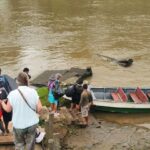
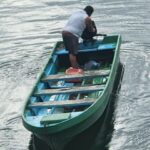
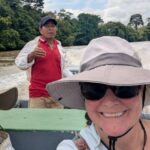
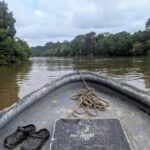
The scenery along the river was beautiful—with lush jungle, majestic egrets dotting the muddy banks like pearls on black velvet, and a mist hovering over the peaks of distant mountains. But the ride? The boat with its splintery wood-plank benches bouncing over waves almost made me question my life choices. I knew my butt and my back would pay for this ride for a few days.
After a two plus hour bumpy ride, we finally arrived at Vista Alegre, a tiny river village that was home to the Wounaan tribe. With apologies that he would not be returning until the morning, our captain tied off his boat and bade us farewell.
We were stranded in a remote Indigenous village with five other passengers who were visiting relatives, or so we thought. There were no hotels, no hostels, no restaurants, and the two stores, smaller than the inside of my bus, each carried about twelve random items, mostly mosquito coils (not a good sign), a small assortment of canned goods, soaps and not much else. It had been a long time since our small breakfast and suddenly the two small bags of peanuts tucked inside my pack became my emotional support snack.
I asked one of our fellow boat mates if she had family in the village. “No,” she said cheerfully, “but I have church family.” She smiled and gestured for us to follow. We gladly shadowed her like two lost puppies with a promise of some kibble.
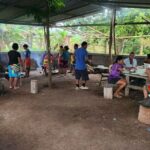
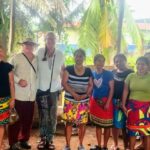
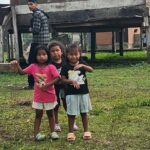
That was how we ended up being adopted, fed and housed by a Wounaan church. We were introduced to the community members and invited to sit on wood benches in a covered pavilion. The women and girls all wore modern shirts and blouses but traditional skirts. The skirts were a knee-length strip of fabric that they simply wrapped several times around their waists and tucked. The designs were all different—from floral to geometric and tribal shapes, but the colors were so brilliant and almost neon-colored that I wondered what they would look like under a black light. Many women, even girls who looked to be as young as eight or nine were tattooed across their chest, back and arms with traditional inking. The meanings, explained to us later, were that the markings announced the women’s position in the village; marital status, a child of a village leader, occupation etc.
No sooner had we settled on the benches than the prophecy of the storm came to pass. With a loud clap of thunder, the clouds released the deluge that had been held in their swollen bellies. The rain pounded deafeningly on the metal roof above our heads and ran off in sheets. The ground surrounding the pavilion soon became saturated and I wondered how long before Noah’s ark might float by.
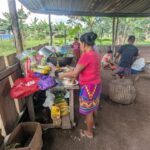
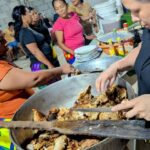
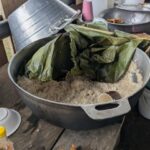
Unphased, the ladies who had been cooking in giant pots over an open flame calmly went about their business filling plates with fried fish and mounds of rice. We were served as if we were not strangers who showed up unexpectedly but rather honored guests they had been waiting for.
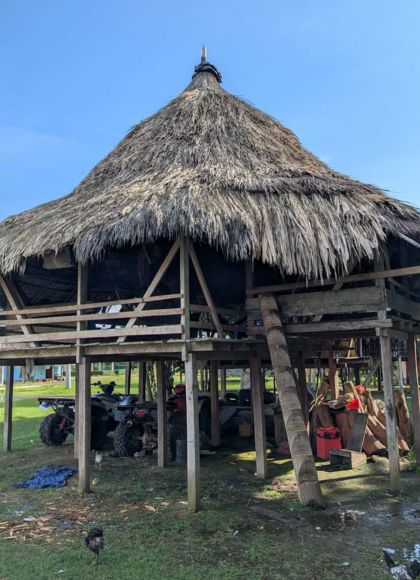
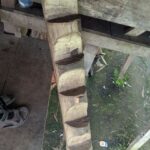
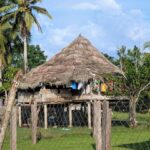
After the meal, a man, who spoke a small amount of English, showed us to our sleeping quarters. A palapa built on stilts with a thatched roof made from palm fronds, it looked like something from an episode of National Geographic. The first thing I noticed was the ladder—or rather log with notches leaning awkwardly against the platform. My first thought was I hope this thing doesn’t roll when I am part way up, followed immediately by how in the hell am I going to navigate that thing to pee in the night.
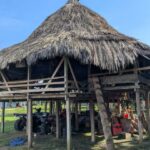
Inside was a simple platform with two net-mesh hammocks hanging from bamboo rafters. We added our two hammocks to the space. By then I was resigned that I was going to need a deep tissue massage if not a chiropractor after this adventure.
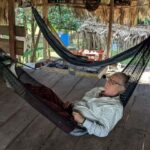
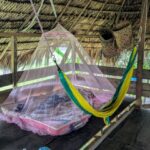
Ainer, the man who spoke some English, was a pastor or church leader at the place where Tomás was parked back in Yavisa, and was also a missionary of sorts to the Wounaan people. He offered to find us a mat and a mosquito net for which I was eternally grateful. Then he encouraged us to take the time after the rains subsided to walk around and explore the village.
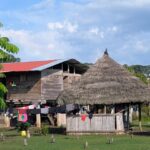
Most of the homes were the same structure as ours, with either bamboo or wood-plank walls and thatched roofs. In the center of town there was a basketball court where we sat for a while and watched barefooted children of varying ages play soccer. One lone girl who looked to be about fourteen played along with several boys, and we cheered just a little bit louder for her. Smells of fried fish, burning garbage, and freshly laundered clothes took turns wafting by. Chickens ran the streets like they were the town council, and roosters crowed their orders with no regard for the time of day.
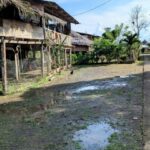
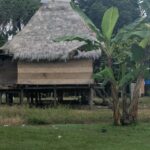
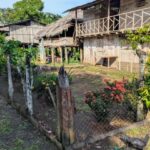
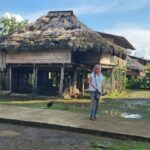
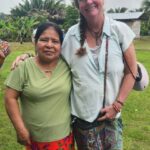
Everyone had a keen interest in our white faces perhaps the only ones some had ever seen. I was a special anomaly at my five-foot ten-inch stature, as most of the Wounaan were no taller than around five-feet tall.
We stopped at one of the only two stores in the village, where I got a bottle of water, and Kevin chose an orange soda. We saw a log near the river’s edge and decided to sit and enjoy our cold drinks while soaking in the amazing views of the muddy river cutting a ribbon through the lush green jungle. As I sat down in my linen pants, damp with both humidity and sweat, I felt something happen. My pants had ripped.
This was not a neat little tear of the seam; this was a flap that let the draft in, no needle and thread was going to fix this mess. We quickly made our way back to the palapa to assess the situation.
“What am I going to do?” I asked rhetorically. “I don’t have anything else to wear.”
“It’s not that bad,” Kevin tried to lie.
But it was that bad, the entire left side of my rear end was exposed by a linen banner flapping in the wind, and I had no change of clothes. Why didn’t I just grab a change of clothes? Then it dawned on me, these were baggy, shapeless linen pants with an elastic waist. “What if I turn them around?”
It worked—somewhat—I now had a gaping hole in the front instead of the back, but I could strategically hang my satchel just so to hide the situation. I made it through dinner (fried chicken, rice and coleslaw-like salad), and an excruciatingly long church service. I felt proud of how much of the sermon I understood, as long as the orator was speaking Spanish. Several locals gave what I assumed was their testimony, in Woun Meu, the language spoken by the Wounaan. The language resembled that of indigenous languages of North America with a hint of the clicks of the Zulu language of Africa.
After the sermon, the chairs of the church were pushed against the walls and music began. We stayed for a bit but soon retired to our palapa. I fell asleep that night to the sounds of traditional music, children’s laughter, howler monkeys and mosquitoes hovering just outside my sagging net. My heart and my belly were full.
The next morning, as we packed up to leave, I realized how quickly the place had changed me. There was something about being surrounded by nature and genuine community that had reset my brain.
If you ever get the chance to visit an Indigenous village — do it. Just don’t forget the bug spray, a sense of humor, and maybe a spare pair of pants.
For more stories of our previous travels check out Andi’s book No Return Ticket